Song Cycle & Vernacular Archives
Nick Irvin
May 17, 2026
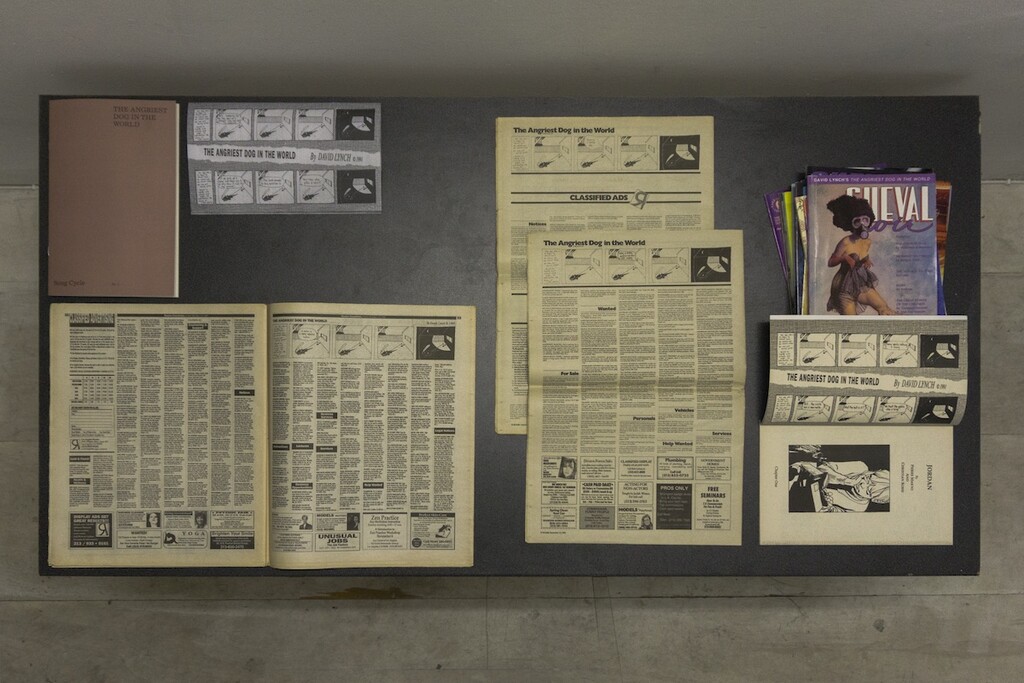
[A tabletop in Song Cycle no. 1: The Angriest Dog in the World. The comic as it appeared in the pages of the LA Reader – jammed between personal ads. Plus its recirculation in the Dark Horse Comics outlet Cheval Noir.]
Song Cycle
Song Cycle is a curatorial project that finds its expression in two halves: a publication (light, affordable, concrete) and some form of exhibition or event (spatial, social, ephemeral). The title’s initial cue came from Van Dyke Parks’ seminal 1967 album by that title: a sprawling, spastic lexicon of Americana, born from the ashes of Brian Wilson’s SMiLE sessions, in which Parks played a brief but decisive role as guest lyricist, arranger, and all-around wunderkind. The album is ornate, loquacious. Gleeful, in a sort of meth-y way. It achieves its effects by the accretion of folk tunes and showtunes, strung into jagged collage and aided by the foremost studio techniques of that opulent era. The project was a money pit, and a critically acclaimed commercial flop. To the artist’s ongoing dismay, the label tried to advertise off this outcome, taking out full-page ads with the sardonic headline: “How we lost $35,509.50 on ‘The Album of the Year’ (Dammit)”.
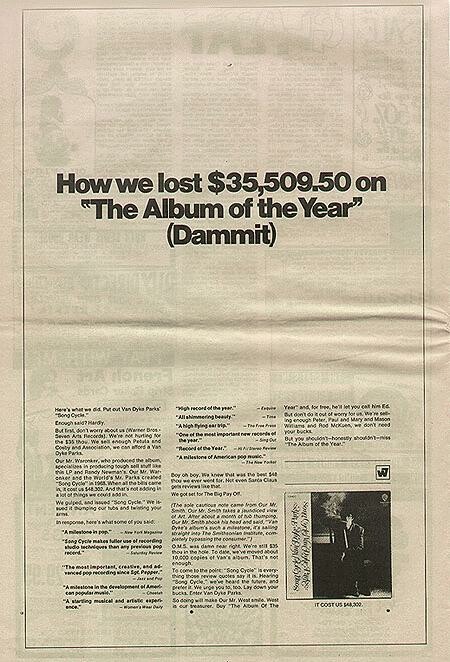
[The infamous Song Cycle ad.]
The album felt like a good guiding star for several reasons. For one, the project would likewise take interest in marginalia and rather vernacular cultural practices. For another, it would be my own money pit, self-financed off of my own middling income, with no interest in turning a profit. The books would be priced to cover production costs, in small batches. Exhibitions would rarely include conventionally saleable artworks, instead preferring print ephemera, video, music, and text. Knowing that monetization was off the table was, among all its difficulties, also freeing. I had seen too many good projects contort themselves before the mantle of financial solvency – or otherwise fail. The day job produced a tiny enclave of dusty bohemian idealism that I hoped to protect.
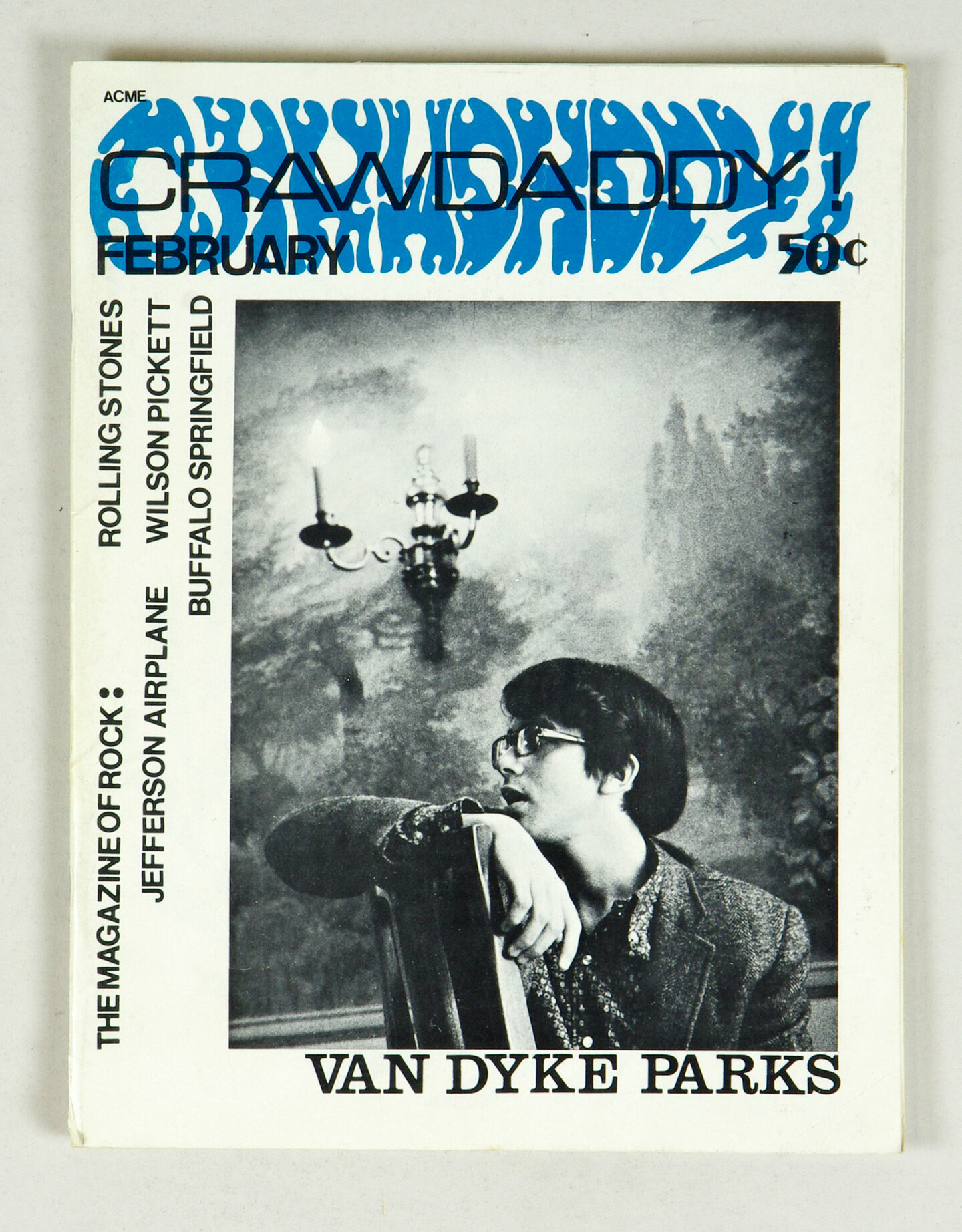
[Van Dyke Parks on the cover of Crawdaddy! No. 13 (February 1968). Crawdaddy was an early vehicle for experiments in writing about rock music: the quintessential “prozine.” Of Parks, Sandy Pearlman writes: “He thinks art is rooted in the anonymous. And that ideas and intentions are getting up in the saddle. Leaving imagination as manipulative, synthetic and sort of irresponsible. Altogether this means that imagination synthesizes readymades that have been turned into anonymous clichés via the information density route of overexposure through constant appearance on your radio (Top 40 and others), your TV and your tradition (folk songs, for example).”]
Behind Parks’s Song Cycle, there is the song cycle as a genre of classical music which is itself hard to pin down. Musicologist Laura Tunbridge writes in her history of the genre that “it can be many things: old, new, small-scale, symphonic, classical, popular, native, exotic, amateur, professional.” In broad strokes, it can be defined by its non-secularity, its interest in “lowness,” and its blending of vernacular form with compositional ambition: less epic than a symphony, but with more coherence and intentional sequence than an anthology or collection. An early dabbling of high and low, with an air of historicism.
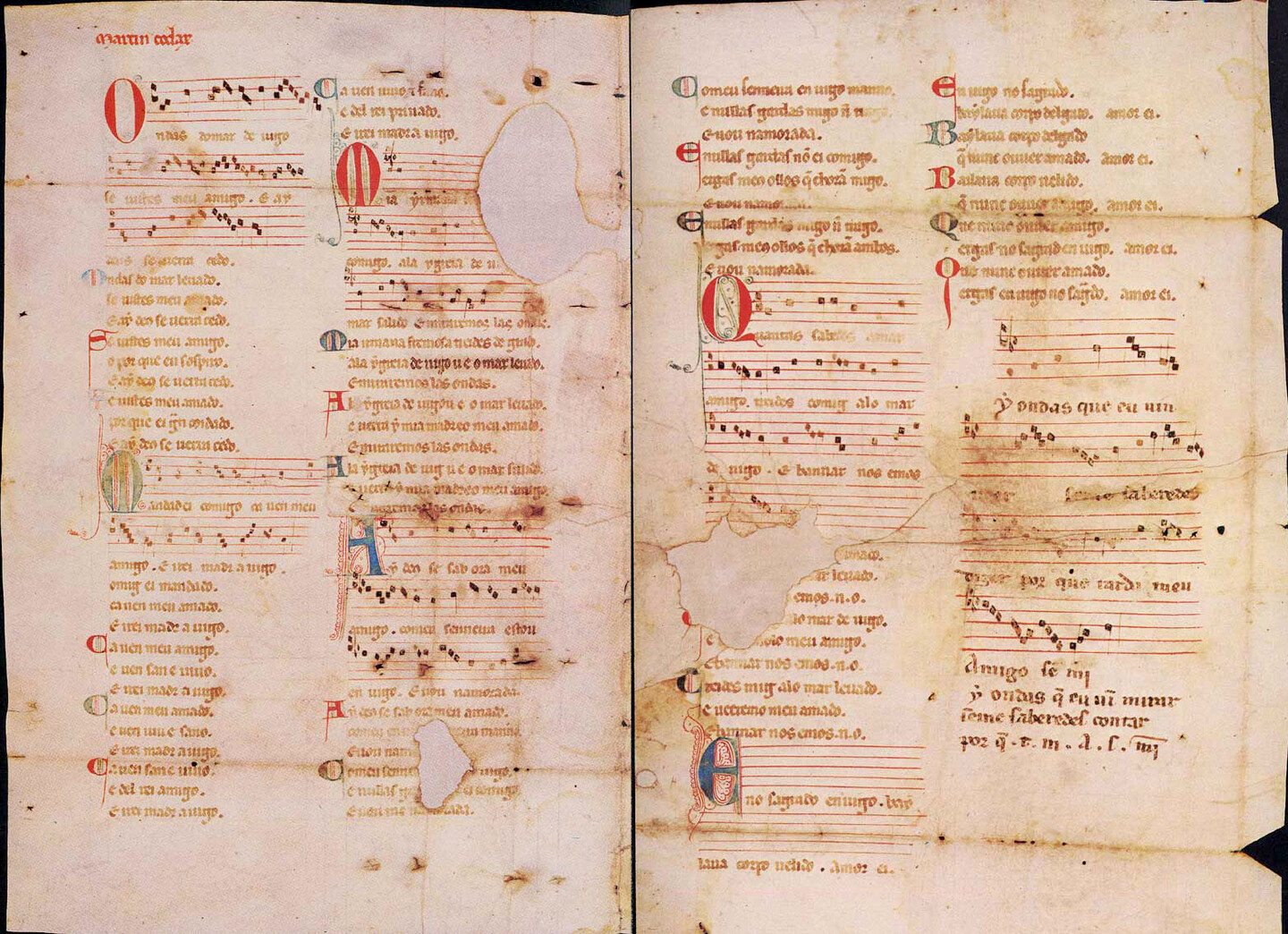
[Perhaps the earliest extant evidence of song cycle: a 13th-century manuscript of 7 cantigas de amigo by Martín Codaz, a Galician musician, held at the Morgan Library. Crucially, Codaz was a non-noble composer and performer: where kings had trobadors, the rest had joglars like Codaz.]
I started to think of my Song Cycle like an album: a series of “songs,” rather than statements, that would ultimately add up to an “album.” From the start I imagined around 10 or 12 projects in the series. To date there are six. The first was an exploration of David Lynch’s long-running comic strip for the long-lost LA alt weekly, Los Angeles Reader: “The Angriest Dog in the World.” The second was a piece of satirical art journalism: an account of an imaginary biennial press junket penned by the dystopian sci-fi collective HEAD Gallery. The third was about Bruno Pelassy, particularly his hand-held video footage of his animatronic “bestiole” sculptures, installed throughout a flophouse in Nice. The fourth was about Gene Beery, and the batches of JPEGs he would email out from his studio in the foothills of the Sierra Nevada mountains – sharing his new paintings with correspondents, but also thematizing rural living and family life as the primary audience for his practice. The fifth was a collection of poems and drawings by Whitney Claflin, on the topics of food and drink. The sixth was about the Gentle Wind Project, a controversial group whose elaborately designed “healing instruments” made their way into the art world, briefly, through the gallery Feature, Inc. and its proprietor, Hudson.
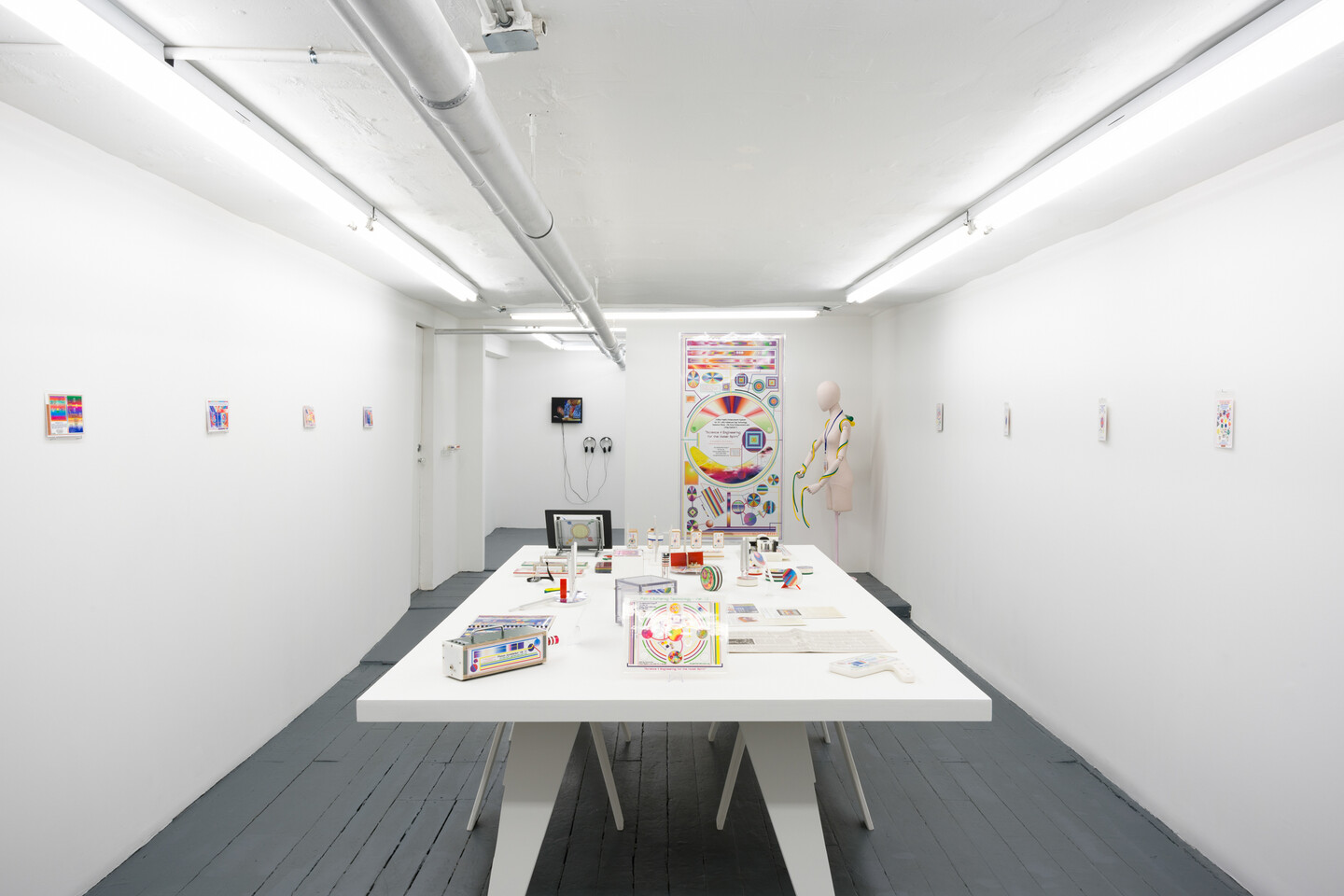
[An installation view of Song Cycle no. 6: “I think of a mustard seed as a battery. From GENTLE WIND PROJECT to I CHING SYSTEMS, 1983-2022,” Theta Gallery, 2023.]
By the time of the sixth project’s publication in 2023, I hit a snag: I went back to school, and in doing so lost my disposable income. (And this after the snag of pandemic.) There has been a big pause, then. To belabor my album metaphor, 6 songs is a reasonable count for “Side A”: I would have to wait for “Side B.” And in that waiting I could take a step back. What was the project about, really? There was enough output to assess now. I’m thankful to KAJE and the Think Tank Residency for giving me time and space to not only make that assessment, but also to get the gears turning on the rest of the sequence.
One throughline that seems clear is an interest in archives. Which is a freighted and ungainly word these days, especially in academic contexts. But I don’t mean institutional archives. Things have been more slapdash, intuitive, and personal than that. It’s more about people’s personal collections of things, which often shades into a creative practice. And rarely does it seem very marketable.
The term I’ve been running with for this set of concerns is “vernacular archives.” Here are some examples of practices that are helping me think through that idea.
Vernacular Archives: Kooks, 70s Zine Culture, the Agustín Parejo School
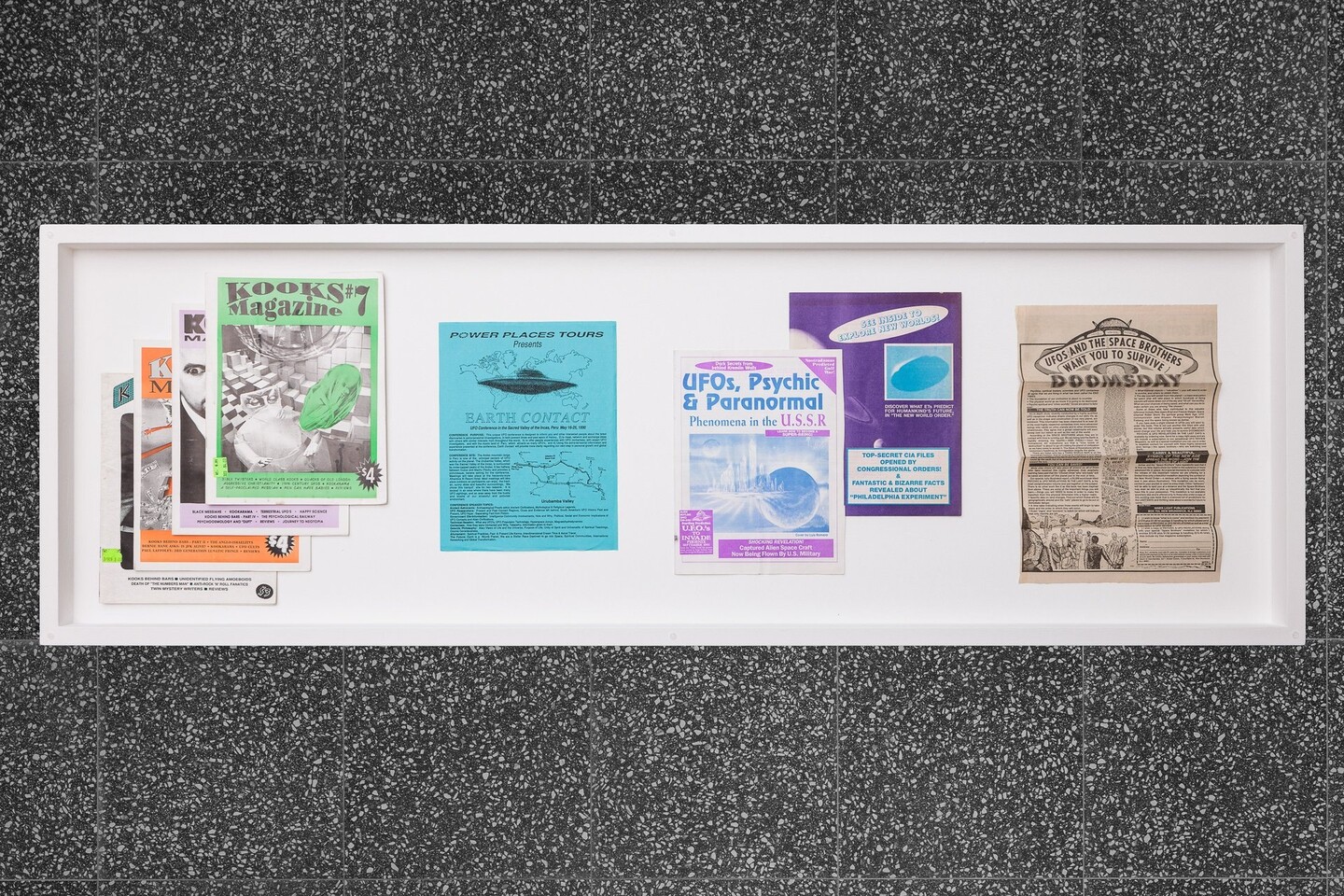
[Kooks Archive: one of five vitrines installed in “Dowsing,” Galerie Emanuel Layr, Vienna, 2023. Left: Kooks Magazine nos. 5-8; Right: Inner Light Publications, various ephemera: “Power Places Tours: Earth Contact: UFO Conference in the Sacred Valley of the Incas, Peru, May 16-25, 1990”; “UFOs, Psychic & Paranormal Phenomena in the USSR,” c. 1991; and a flyer: “UFOs and the Space Brothers Want You To Survive Doomsday,” n.d.]
Kooks was a zine published by artist and bookseller Donna Kossy from the late eighties to the early nineties. It introduced readers to fringe thinkers, movements, and makers, operating at what Kossy would call “the Outer Limits of Human Belief.” It began, she tells me, by collecting xeroxed ravings of madmen who stapled their cryptic messages to telephone poles in San Francisco. It led her in many directions: UFO groups, naturally; magazines that looked like rock zines but were in fact traps laid by fundamentalist Christian groups (R.O.C.K.: Reborn Of Christ’s Kingdom); the Voluntary Human Extinction Movement (“May We Live Long and Die Out”); the original screeds of Dr. Bronner; the art and writings of visionary artist Paul Laffoley (1935-2015). Kossy amassed an impressive collection of paraphernalia that tells these stories. In 2023, she allowed me to exhibit selections in a show I organized at Galerie Emanuel Layr in Vienna, which was about belief, fringe thinking, and art’s strange and irresponsible ways of forming an understanding of the world. Kossy approaches this material with the steady hand of a bibliographer, but a certain openness, too.
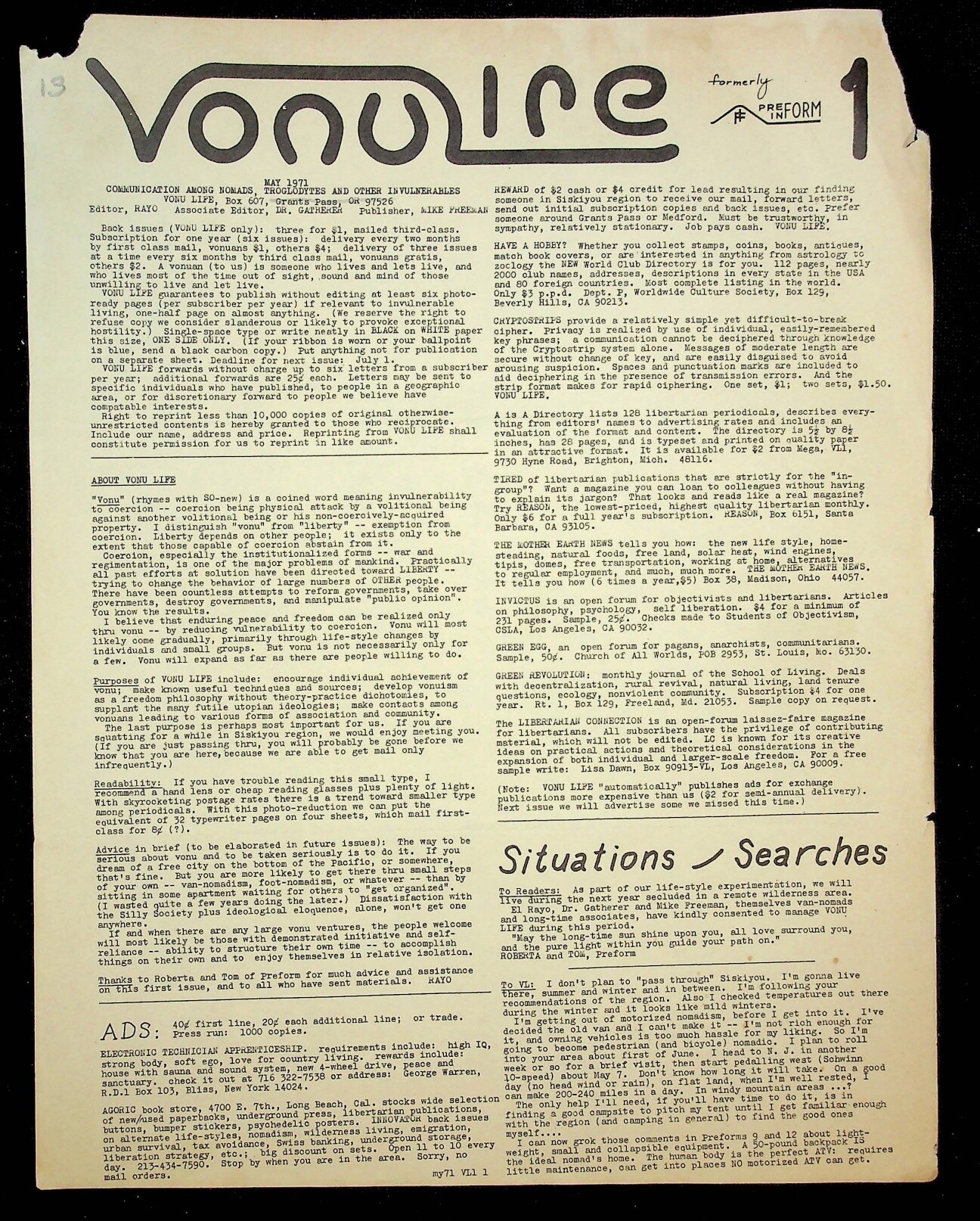
[VONU LIFE no. 1: a libertarian/survivalist fanzine circulated by Paul Doerr, c. 1973.]
Jarret Kobek is a novelist who published a pair of books in 2022 detailing his development of a new theory of the Zodiac Killer (How To Find Zodiac and Motor Spirit: The Long Hunt for the Zodiac, both published by We Heard You Like Books). Using the analytic tools of literary analysis, Kobek identified a new suspect: Paul Doerr, a North Bay resident who was a prolific fanzine publisher, at a time when this meant mailing out batches of photocopies to small networks of fellow travelers. Doerr’s interests were varied: he published on Tolkien, survivalism, neopaganism, cryptography, and Renaissance Fairs. Kobek found that he was also a member of the right-wing militia the Minutemen. Kobek says he did not set out to identify a new Zodiac suspect; rather, he was researching fanzine culture in this period, and Doerr’s PO Box kept coming up in different contexts. Digitization and OCR-reading allowed Kobek to parse vast sets of text in disparate archives that otherwise would not have been put into dialogue – enabling him to track the repetition of addresses and phrases across zines. Since publishing, the Doerr theory has made waves among researchers of the Zodiac Killer case; true crime researcher Paul Haynes told the Guardian that Doerr is the “best Zodiac suspect that’s ever surfaced.”
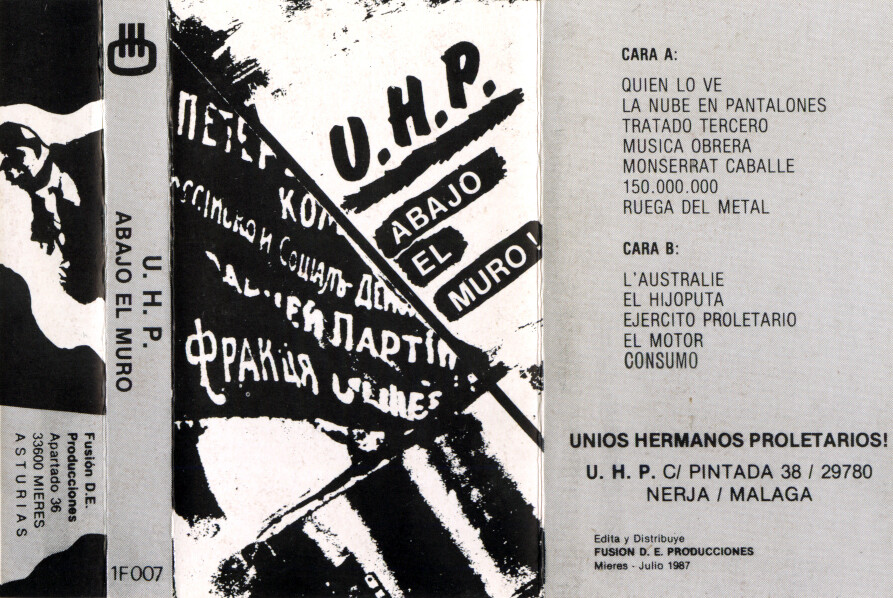
[Cassette insert for U.H.P.: Abajo el Muro (Fusión D.E. Producciones, 1987)]
When I visited the Museo Reina Sofia in Madrid last year, I learned about the Agustín Parejo School, a conceptual art collective from Málaga active from 1982 to 1994. Their output is multifarious, but it circles around a commitment to leftist politics in the peculiar, fragile context of post-dictatorship Spain. Unlike the other European fascists of World War II, Franco held on to power until 1975. The country then experienced a belated “democratization” and reconciliation with the legacies of the Spanish Civil War, long after the Soviet Union had lost its integrity for most leftist observers. Out of this context, members of the Agustín Parejo School formed a band titled U.H.P. (“Unios Hermanos Proletarios!”): a sludgy no-wave band whose lyrics and imagery were wrapped up in a repertoire of orthodox Communist sloganeering, similar in concept (if not soundscape) to Art & Language and The Red Krayola’s 1976 album Corrected Slogans. The U.H.P. tapes are, of course, rare. But again, the internet offered up a miracle: searching for mentions of the band on the Wayback Machine, I found a music blog that had posted a Mediafire link to a download of .FLAC files for the U.H.P. tape Abajo el Muro. Miraculously, the Mediafire link still worked! It’s nice to think that somehow, despite antipiracy purges and link rot, the obscure Blogspot of some noise music nerd was still able to reach me in 2026, redelivering this strange project from oblivion.
- Nick Irvin